
Surgical Excellence Doesn't Scale. Here's What We Can Do About It.
The world's most advanced surgical techniques are concentrated in a handful of institutions. The patients who need them are everywhere else.
Mr Amyn Haji, Consultant Colorectal Surgeon & Interventional Endoscopist, King's College Hospital | CEO, Mentix
There is an uncomfortable truth at the heart of global surgical training, and it is rarely stated plainly: the way surgical expertise is currently transmitted is fundamentally incompatible with the scale of need it is meant to serve.
The dominant model is apprenticeship. A trainee identifies a procedure they need to learn, finds a centre of excellence that offers formal or informal training, applies for a fellowship, relocates for several months, watches and assists a consultant perform a high volume of cases, and — if they are dedicated and the timing is right — begins to develop competence. They then return to their home institution and, ideally, continue building that competence through their own case load.
For certain procedures, in certain settings, this model has worked remarkably well. My own training in advanced colonoscopy with Professor Kudo at Showa University in Japan was formative in ways that no amount of reading or video review could have replicated. The volume, the feedback, the opportunity to develop the specific motor and perceptual skills that ESD demands — all of it required physical presence, close observation, and the kind of iterative correction that only comes from working directly alongside someone who has done the procedure thousands of times.
The limits of the fellowship model
But the fellowship model scales poorly. It requires trainees to be geographically mobile, financially supported, and already connected to the networks through which elite fellowships are advertised and allocated. It concentrates training capacity in institutions that are typically located in high-income countries and already well-resourced. And it produces expertise at a rate that bears no meaningful relationship to global procedural demand.
"High-volume training of fellows in colorectal ESD is feasible and safe in Western centres — but the structural conditions to replicate this at global scale do not yet exist." — Haji et al., ACPGBI Annual Meeting
Consider the scale of the challenge. Colorectal cancer is the third most common cancer globally. Bowel cancer screening programmes in the UK alone generate tens of thousands of colonoscopies each year, a proportion of which will identify lesions requiring advanced endoscopic intervention. Across the NHS, the number of endoscopists with the full range of competencies required — magnification endoscopy, ESD, colonoscopic ultrasound staging — remains small relative to the demand created by screening expansion. Internationally, the disparity is more acute still.
Colorectal cancer ranks third among cancers globally by incidence. Estimated global colorectal cancer deaths exceed 935,000 per year (2020 data). Very few centres globally are capable of high-volume colorectal ESD outside Japan.
The result is a two-tier system. Patients who happen to live near an expert centre — and who are referred appropriately, which is itself not guaranteed — receive organ-preserving endoscopic treatment. Patients who do not are referred for surgery that carries significantly greater morbidity, longer recovery, and in some cases, permanent functional consequences. The clinical difference between these two groups is not a function of disease severity. It is a function of postcode.
Where technology changes the calculus
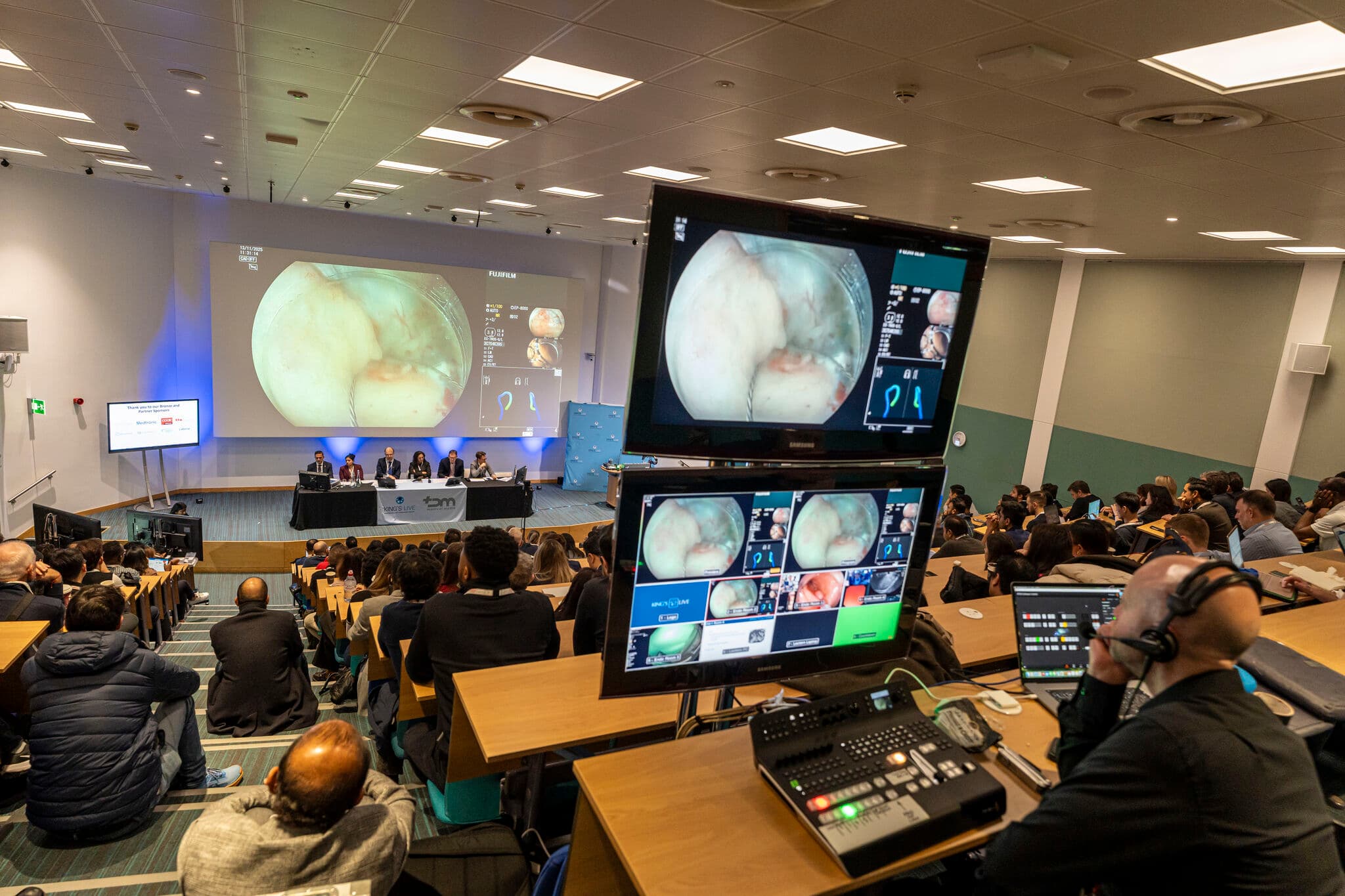
Remote proctoring does not replace the fellowship. It does not eliminate the need for hands-on training, for supervised practice, for the slow accumulation of procedural competence that only comes from doing. What it does is extend the mentorship relationship beyond the period and geography of the fellowship itself — allowing an experienced endoscopist to observe and guide a trainee during live procedures from a different location, long after the formal training period has ended.
This matters enormously for the post-fellowship phase of surgical development, which the traditional model handles poorly. A surgeon who has completed a fellowship at King's or Showa University returns home with a foundation of competence — but they return without their mentor. The cases they encounter in the early months of independent practice are precisely the cases where expert oversight would be most valuable. The traditional model offers nothing in that period. Remote proctoring offers continuity.
It also opens the possibility of structured, scalable credentialling. If expert proctors can observe practice remotely, assessment can become continuous rather than episodic. Competence can be demonstrated in real clinical conditions rather than in the artificial environment of an examination. Accreditation bodies can develop confidence in practitioners they have never met in person, based on a sustained record of observed and evaluated practice.
Mentix was built on this insight. Our platform connects surgical trainees with expert proctors for real-time remote guidance, structured case review, and continuous competence assessment — enabling the kind of mentorship that currently exists only within the walls of a small number of elite institutions to reach practitioners anywhere in the world. The expertise already exists. The patients already exist. What Mentix provides is the infrastructure to connect them — at the scale the problem demands.
Institutions and technology providers can explore how to partner with Mentix.
The question of how surgical expertise travels is not an abstract academic concern. It is, in the most direct sense, a question of which patients receive the best available treatment for their condition and which do not. The fellowship model has served the field well. But it was designed for a world in which geography was an immovable constraint, and we no longer live in that world. The tools exist to do better. The obligation now is to use them.